
Islamic Inheritance Calculatorاسلامی وراثت کیلکولیٹر
Calculate Hanafi/Sunni faraid shares for property and estate distribution in Pakistan.پاکستان میں جائیداد کی تقسیم کے لیے حنفی/سنی وراثت کے حصے نکالیں
How to Use / استعمال کرنے کا طریقہ
- Select the deceased's gender and sect (Hanafi is default for Pakistan) / متوفی کی جنس اور مسلک منتخب کریں (حنفی پاکستان کے لیے ڈیفالٹ ہے)
- Enter estate value and land area in Kanal/Marla/SqFt / جائیداد کی مالیت اور رقبہ کنال/مرلہ/مربع فٹ میں درج کریں
- Enter the number of surviving heirs / زندہ ورثاء کی تعداد درج کریں
- Click Calculate to see each heir's share / حساب کرنے پر کلک کریں تاکہ ہر وارث کا حصہ دیکھیں
Islamic Inheritance Calculatorاسلامی وراثت کیلکولیٹر
Calculate Hanafi/Sunni faraid shares based on Quranic law (Surah An-Nisa 4:11-12, 4:176).قرآنی قوانین کی بنیاد پر حنفی/سنی وراثت کے حصے
Currently calculating according to Hanafi school. Other schools have slight differences in some rules.فی الحال حنفی مسلک کے مطابق حساب کیا جا رہا ہے۔ دوسرے مسالک میں بعض قواعد میں معمولی فرق ہے۔
Islamic Inheritance in Pakistan — Complete Guide to Faraid (وراثت)
Islamic inheritance, known as Faraid (فرائض) or Wirasat (وراثت), is governed by clear rules laid out in the Quran (Surah An-Nisa, verses 4:11-12 and 4:176). In Pakistan, these rules are codified under the West Pakistan Muslim Personal Law (Shariat) Application Act, 1962, which applies to all Muslim citizens. Understanding these rules is essential for anyone dealing with property inheritance in Pakistan.
The Legal Basis for Islamic Inheritance in Pakistan
Pakistan follows Hanafi jurisprudence (the predominant school among Pakistani Sunnis) for inheritance matters. The key laws are:
- West Pakistan Muslim Personal Law (Shariat) Application Act, 1962 — This is the primary law that applies Islamic inheritance rules to all Muslims in Pakistan.
- Muslim Family Laws Ordinance, 1961 (Section 4) — This important provision grants inheritance rights to orphaned grandchildren whose parent died before the grandparent. Without this law, they would be excluded under strict Hanafi rules.
- Quranic verses (Surah An-Nisa 4:11-12, 4:176) — These verses establish the fixed shares (Furud) for each heir.
Fixed Quranic Shares (Ashab al-Furud)
Islamic inheritance law assigns fixed shares (Furud) to specific heirs. These shares are fractions of the estate that cannot be changed by a will. Here are the key shares:
- Husband: 1/2 of the estate if the wife has no children; 1/4 if she has children.
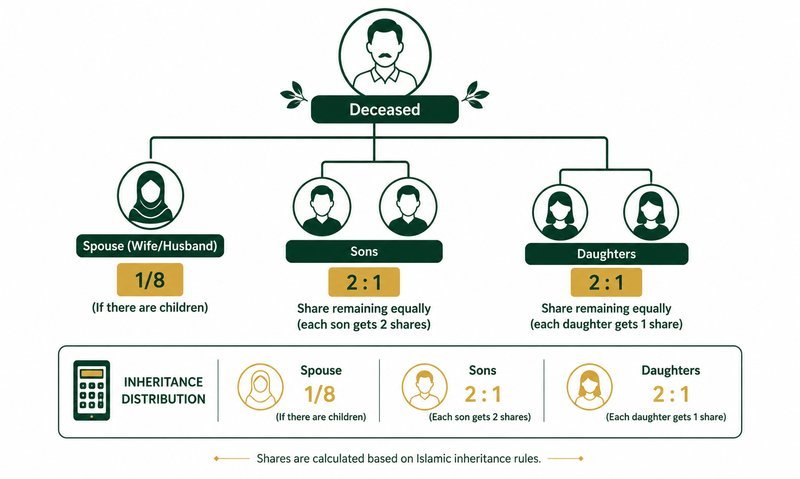
- Wife: 1/4 if the husband has no children; 1/8 if he has children. All wives share this portion equally.
- Daughter (one, no son): 1/2 of the estate.
- Two or more daughters (no son): 2/3 of the estate, shared equally among them.
- Sons and daughters together: The residue is divided in a 2:1 ratio — each son gets twice the share of each daughter.
- Mother: 1/6 if the deceased has children or two or more siblings; 1/3 if no children and fewer than two siblings.
- Father: 1/6 plus the residue if the deceased has children; full residue if no children.
Example — Widow, Mother, and Two Sons: A man in Lahore passes away leaving a widow, his mother, and two sons. The estate is a 10 Marla plot (2,722.5 sq ft at 272.25 standard). The widow receives 1/8 (12.5% = 340.3 sq ft), the mother receives 1/6 (16.67% = 453.75 sq ft), and the remaining 71.83% goes to the two sons in equal shares — each son gets 35.91% (977.8 sq ft).
Hajb (Exclusion) Rules — Who Gets Excluded?
Hajb (حجب) refers to the rules of exclusion in Islamic inheritance. Certain heirs are excluded from inheritance when closer relatives exist. Key exclusion rules include:
- A son excludes: all siblings (brothers and sisters), grandchildren, and grandparents (except the father).
- A father excludes: siblings (under Hanafi rules).
- Children reduce the spouse's share: Husband goes from 1/2 to 1/4; Wife goes from 1/4 to 1/8.
- Two or more daughters exclude: full and consanguine sisters (unless there is a son).
Radd (Surplus Return) and Aul (Oversubscription)
Two special situations can arise in inheritance calculations:
- Radd (رد) — Surplus Return: If the total fixed shares add up to less than 1 (the whole estate), the surplus is returned proportionally to the non-spouse sharers. The spouse does NOT participate in Radd under Hanafi law. For example, if the Wife gets 1/8, Mother gets 1/6, and Father gets 1/6, the total is 11/24, leaving a surplus of 13/24 that goes to the Son as a residuary.
- Aul (عول) — Oversubscription: If the total fixed shares exceed 1, all shares are reduced proportionally. For example, if the Husband (1/2) + two Daughters (2/3) + Mother (1/6) = 9/6 = 1.5, all shares are multiplied by 6/9 = 2/3. The Husband gets 1/3, the Daughters get 4/9 each, and the Mother gets 1/9.
The Calculation Process — Step by Step
Our calculator follows this process automatically, but here is how it works:
- Settle debts and funeral expenses — These are paid from the estate before any distribution to heirs.
- Apply bequests (Wasiyat) — Up to 1/3 of the remaining estate can be willed to non-heirs. Bequests to legal heirs are not valid without consent of other heirs.
- Identify surviving heirs — Determine which relatives are alive at the time of death.
- Apply Hajb (exclusion) — Remove heirs who are excluded by closer relatives.
- Assign fixed shares (Furud) — Give each eligible heir their Quranic share.
- Distribute the residue — The remaining estate goes to residuaries (Asaba), with sons getting twice the share of daughters.
- Apply Radd or Aul — Adjust for surplus or oversubscription as needed.
See also: Property Share Calculator for dividing inherited property among co-owners, and Property Tax Calculator for understanding tax implications of inherited property transfers.
Frequently Asked Questions about Islamic Inheritance
How is property divided among heirs in Islam?+
Islamic inheritance (Faraid) divides property according to fixed Quranic shares. The estate is first used to settle debts and funeral expenses, then up to 1/3 can be willed to non-heirs. The remaining estate is distributed to legal heirs based on their prescribed shares. Sons typically get twice the share of daughters (2:1 ratio).
What is the wife's share in inheritance when there are children?+
When the deceased has children, the wife receives 1/8 (12.5%) of the estate. If there are no children, the wife receives 1/4 (25%). All wives share this portion equally. For example, if a man with two wives and three children passes away, both wives together get 1/8, split equally between them.
How much do daughters inherit in Islam?+
If there is only one daughter and no son, she inherits 1/2 of the estate. If there are two or more daughters and no son, they inherit 2/3, shared equally. If there are both sons and daughters, the sons get twice the share of daughters (2:1 ratio). For example, with 1 son and 1 daughter, the son gets 2/3 of the residue and the daughter gets 1/3.
What is the difference between Faraid and Wirasat?+
Faraid (فرائض) refers specifically to the fixed Quranic shares assigned to each heir — these are the compulsory portions. Wirasat (وراثت) is the broader term for inheritance, encompassing the entire process of estate distribution including Faraid, residuary shares, and legal procedures.
Can a will override Islamic inheritance shares?+
No. Under Islamic law and Pakistan's Shariat Act 1962, a will (Wasiyat) cannot override the fixed Quranic shares of legal heirs. A will can only dispose of up to 1/3 of the estate to non-heirs. Bequests to legal heirs are not valid without the consent of all other heirs.
What happens if the total shares exceed the estate (Aul)?+
When fixed shares add up to more than the estate, all shares are reduced proportionally through a process called Aul (عول). For example, if Husband (1/2) + two Daughters (2/3) + Mother (1/6) = 1.5× the estate, each share is multiplied by 2/3. The calculator handles this automatically.
Do adopted children inherit in Islamic law?+
Under strict Hanafi Islamic law, adopted children do not automatically inherit from their adoptive parents. However, the adoptive parent can will up to 1/3 of their estate to the adopted child. The Muslim Family Laws Ordinance 1961 (Section 4) grants inheritance rights to orphaned grandchildren.
How is agricultural land divided among heirs?+
Agricultural land is divided the same way as any other property under Islamic inheritance law. However, the physical division of agricultural land (partition) may be subject to additional rules under the Punjab Land Revenue Act and may require Patwari involvement for mutation (Intiqal) of land records.
What is the share of a mother in Islamic inheritance?+
The mother receives 1/6 of the estate if the deceased has children or two or more siblings. If there are no children and fewer than two siblings, the mother receives 1/3. The mother's share is always a fixed Quranic share (Fard).
How do I register inheritance property in my name in Pakistan?+
After calculating the shares using our calculator, you need to visit the Patwari's office to file a mutation (Intiqal) application. The Patwari will update the Fard (ownership record) to reflect the new shares. You will need the death certificate, Fard of the deceased, CNICs of all heirs, and inheritance certificate from the union council. For complex cases, consult a property lawyer.