
Pakistan Land Records Guide
پاکستان کے زمینی ریکارڈز کی مکمل رہنما — فرد، جامابندی، خطاونی، کھوت، خسرہ
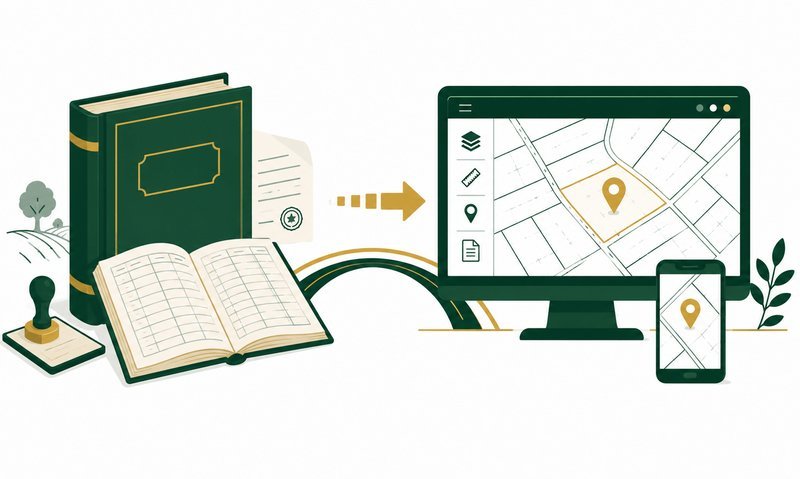
Understand Pakistan's land records system — from the British-era Patwari system to modern computerized portals. Learn what each document means, how to check your Fard online, and which government portal to use for your province.
Punjab Land Records (PLRA)
پنجاب لینڈ ریکارڈز اتھارٹی
The Punjab Land Records Authority (PLRA) was established in 2016 under the Punjab Land Records Authority Act to digitize and manage all land records in Punjab. PLRA has computerized over 50 million records across all 36 districts, making it the most advanced land records system in Pakistan. Through the PLRA portal, you can check your Fard Malikanat online, track mutations, view Aks-Shajra (satellite field maps), and download certified copies.
What is Fard Malikanat?
Fard Malikanat (فرد مالکانت) is a certified extract from the revenue record showing current ownership of a specific piece of land. It contains the Khewat number, Khasra number, Khatauni number, names of all owners with their shares, total area, cultivation details, and any encumbrances or mutations.
Before PLRA, getting a Fard meant visiting the Patwari's office and waiting days. Now you can download it from the PLRA portal in minutes.
How to Check Your Fard Online — Step by Step
Visit PLRA Portal
Go to plra.punjab.gov.pk on your phone, tablet, or computer. The portal works on all devices.
Select Your District
Choose your district from the dropdown menu. Punjab has 36 districts, all covered by PLRA.
Select Tehsil & Mauza
Select your tehsil (sub-district) and then your mauza (village/mouza). If unsure, ask your Patwari or check your existing documents.
Enter Khasra Number
Enter the Khasra number of your plot. You can also search by CNIC if your record is linked to your ID card.
View & Download Fard
The system will display your Fard with all ownership details. You can view it online or download as PDF.
Get Certified Copy (Optional)
For official use, visit a PLRA service center with your CNIC and PKR 100-200 fee to get a certified printed copy.
Required Documents for PLRA Services
- Computerized National Identity Card (CNIC) — original and copy
- Khasra number of the plot (if known)
- Mauza (village) name, tehsil, and district
- For mutation: Sale deed / inheritance certificate / gift deed
- For certified Fard: PKR 100-200 fee at service center
- For Aks-Shajra: Plot location details or existing Shajra
Understanding Pakistan Land Records
Pakistan's land records system is one of the oldest and most complex in the world, tracing its roots back to the British colonial era. The system was formalized in the late 19th century under the Punjab Land Revenue Act of 1887 and has evolved through decades of computerization efforts. Today, each province maintains its own digital land records portal, making it possible to check fard online from anywhere in the world.
The Patwari System — A Historical Overview
At the heart of Pakistan's land records system is the Patwari — a village-level revenue officer responsible for maintaining and updating land records for their assigned circle (Patwar Circle). The Patwari system was established by the British in the 19th century to systematically record land ownership, cultivation, and revenue collection. Each Patwari maintains several key registers: the Roznamcha (daily diary of mutations and changes), the Jamabandi (settlement record updated every 4 years in Punjab), and the Shajra (field maps showing plot boundaries).
The system underwent a major transformation starting in the 2000s with theLand Records Management and Information System (LRMIS) project, which aimed to digitize all land records. Punjab led the way with thePunjab Land Records Authority (PLRA), established in 2016, which computerized over 50 million records across all 36 districts. Sindh followed withSindh Zameen, KPK with its KPLR portal, and Balochistan with its own digitization efforts. Islamabad Capital Territory records are managed by the Capital Development Authority (CDA).
What is Fard Malikanat?
Fard Malikanat (also called Fard-e-Malikanat or simply Fard) is the most important land document in Pakistan. It is a certified extract from the revenue record that shows the current ownership of a specific piece of land. The Fard contains critical information including the Khewat number (account number for co-owners), Khasra number (the specific field/plot number),Khatauni number (holding details), the names of all owners with their shares, the total area, cultivation details, and any encumbrances or mutations.
Before computerization, getting a Fard meant visiting the Patwari's office and waiting days or weeks. Today, you can check fard online through province-specific portals in minutes. In Punjab, the PLRA portal allows you to download a Fard by entering your district, tehsil, mauza (village), and Khasra number. You can also search by CNIC in some provinces.
Jamabandi — The Settlement Record
Jamabandiis the periodic settlement record of land in a village or estate. In Punjab, it is updated every 4 years (called a “settlement period”). The Jamabandi is a comprehensive document that lists all landowners, their shares, cultivation details, and the rights and liabilities attached to each piece of land. It is the foundational document from which Fards and other extracts are derived. The term comes from the Persian word “Jamabandi” meaning “binding of revenue” — it was originally created to assess and collect land revenue.
Khatauni, Khewat, and Khasra — The Three Pillars
Every piece of land in Pakistan's revenue system is identified by three key numbers:
- Khewat (کھوت): This is the account number assigned to a group of co-owners who share ownership of one or more properties. Think of it as a family or clan account. All co-owners in a family will share the same Khewat number. When property is divided through inheritance or sale, new Khewat numbers may be created.
- Khasra (خسرہ):This is the unique field number assigned to each individual plot of land within a mauza (village). The Khasra number is the most granular identifier — it refers to a specific piece of land with defined boundaries. When you hear someone say “Khasra number 123,” they are referring to a specific plot.
- Khatauni (خطونی): Also called Khatuni, this is the holding detail that shows which specific plots are owned or cultivated by which person. It links the Khewat (owner account) to the Khasra (specific plot).
Mutation (Intiqal) — How Ownership Changes
Mutation (called Intiqal in Urdu) is the official process of transferring land ownership from one person to another. This happens when a property is sold, inherited, or gifted. The process involves:
- Filing an application with the Patwari or at the PLRA service center
- Verification of documents (sale deed, inheritance certificate, etc.)
- Issuance of a Tariq (official order for mutation)
- Entry in the Roznamcha (Patwari's daily diary)
- Publication of notice for objections (usually 30 days)
- Final entry in the Jamabandi at the next settlement
In Punjab, mutations can now be tracked online through the PLRA portal. The entire process, which once took months, can now be completed in 15-30 days in digitized areas.
Aks-Shajra and Field Maps
Shajra (شجرہ) is the traditional field map drawn by Patwaris showing plot boundaries, landmarks, and neighboring properties. Aks-Shajra (عکس شجرہ) is a modern innovation that overlays these field boundaries on satellite imagery, creating a powerful tool for land verification. The PLRA portal now provides Aks-Shajra for many digitized areas, allowing landowners to see their plot boundaries on satellite maps. This is especially useful for resolving boundary disputes and verifying plot locations before purchase.
Girdawari — The Harvest Inspection
Girdawari (گرداوری) is the twice-yearly harvest inspection conducted by the Patwari. During Girdawari, the Patwari visits each field, records what crop is being grown, assesses the condition, and updates the revenue record. This information is used for agricultural statistics, crop insurance, and revenue assessment. Girdawari records are also important for establishing possession and cultivation rights, which can be crucial in land disputes.
Land Measurement Units in Revenue Records
Pakistan's land records use a mix of traditional and metric units. The most common units you will encounter in a Fard or Jamabandi are:
- Murabba (مربعہ): 25 acres — the largest traditional unit, used for large agricultural holdings. A standard Murabba is a square of 36 Karam × 40 Karam × 25.
- Killa (کلہ): 1 acre = 8 Kanal = 43,560 sq ft. In revenue records, a standard Killa measures 36 Karam × 40 Karam.
- Kanal (کنال): 20 Marla = 5,445 sq ft (at 272.25 standard).
- Marla (مرلہ): 272.25 sq ft (revenue standard) or 225 sq ft (urban).
- Sarsai (سرسائی): 30.25 sq ft = 1/9 of a Marla.
Why Land Records Matter
Accurate land records are essential for property rights, agricultural planning, tax collection, and dispute resolution. Pakistan's land records system affects millions of landowners, farmers, and property buyers. Understanding how to read a Fard, what a Khewat number means, and how to check your land records online can save you from fraud, boundary disputes, and legal complications. The computerization of land records has been one of the most significant governance reforms in Pakistan, reducing corruption, speeding up transactions, and making land records accessible to ordinary citizens.
Whether you are buying property, inheriting land, settling a family dispute, or just curious about your ancestral land, knowing how to access and interpret Pakistan's land records is an essential skill. Use the tabs above to find the right portal for your province, and refer to the glossary for any unfamiliar terms.
See also: Khewat & Khasra Number Decoder for decoding your land record numbers, and Killa Grid & Aks-Shajra Tool for viewing revenue maps on satellite imagery.
Frequently Asked Questions about Pakistan Land Records
How can I check my Fard online in Punjab?+
Visit the PLRA portal at plra.punjab.gov.pk. Select your district, tehsil, and mauza (village), then enter your Khasra number. You can also search by CNIC if your record is linked. The Fard is available for download as a PDF. Alternatively, visit lrms.punjab.gov.pk for the legacy LRMS portal.
What is the difference between Fard and Jamabandi?+
A Fard (Fard Malikanat) is a certified extract showing current ownership of a specific plot. Jamabandi is the comprehensive settlement record of an entire village or estate, updated every 4 years in Punjab. The Fard is derived from the Jamabandi. Think of Jamabandi as the master record and Fard as a snapshot of one entry.
How do I find my Khasra number?+
Your Khasra number is the unique field number for your plot in the revenue record. You can find it on your existing Fard, Jamabandi, or property deed. If you don't have any documents, visit your local Patwari or PLRA service center with your property address and CNIC. In digitized areas, you can search by CNIC on the PLRA portal.
What is a mutation (Intiqal) and how long does it take?+
Mutation (Intiqal) is the official transfer of land ownership. In Punjab, the process takes 15-30 days after application. It involves verification, publication of notice, and final entry. You can track mutation status online through the PLRA portal using your application number.
Can I check land records by CNIC in Pakistan?+
Yes, in Punjab you can search land records by CNIC through the PLRA portal (plra.punjab.gov.pk). In Sindh, the Sindh Zameen portal (sindhzameen.gos.pk) also supports CNIC-based search. KPK's KPLR portal (kplr.gkp.pk) supports CNIC search in digitized areas. Note that not all records may be linked to CNIC — older records may still require Khasra number search.
What documents do I need to get a Fard from PLRA?+
To get a Fard from PLRA, you need: (1) Your CNIC, (2) The Khasra number of the plot, (3) The mauza (village) name, (4) Tehsil and district information. If you don't know the Khasra number, you can search by CNIC. For a certified copy, visit a PLRA service center with PKR 100-200 fee. Online Fards are free for viewing but may have a small fee for certified downloads.
What is the role of a Patwari in land records?+
The Patwari is the village-level revenue officer responsible for maintaining and updating land records. They conduct Girdawari (harvest inspection), record mutations, maintain the Roznamcha (daily diary), prepare Fards, and assist with land measurement. Each Patwari covers a Patwar Circle of several villages. Despite computerization, Patwaris remain essential for field verification and local knowledge.
How do I check land records in KPK?+
Visit the KPK Digital Land Records Portal at kplr.gkp.pk. Select your district, tehsil, and mauza, then search by Khewat/Khasra number or CNIC. You can also book an appointment at a Service Delivery Centre (SDC) for in-person assistance. The portal covers Phase I and Phase II digitized districts.
How do I verify property in Islamabad (ICT)?+
For CDA-controlled areas in Islamabad, use the CDA Online Property Verification portal at cda.gov.pk/public/onlinePropertyVerification. Register for an IPVS account, log in, and search by sector/plot number. The report includes verified details from CDA's Housing, Estate, and Land Directorates. For non-CDA areas, contact the ICT Administration's revenue office.
What is Aks-Shajra and how is it different from a regular Shajra?+
Shajra is the traditional hand-drawn field map maintained by Patwaris showing plot boundaries. Aks-Shajra (عکس شجرہ) is a digital overlay of these field boundaries on satellite imagery. Aks-Shajra provides a real-world view of your plot, making it easier to verify boundaries, identify encroachments, and resolve disputes. The PLRA portal provides Aks-Shajra for many digitized areas in Punjab.